Featured post

THE NORMAN INVASION

(1)    1066 was a very important year for Anglo-Saxon England. There were 3 Kings, 2 Battles, and a comet. There hasn't been anoth...

Showing posts with label Stephen and Matilda. Show all posts

Sunday, 22 February 2015

STEPHEN and MATILDA ~ 1141-1154


A Penny issued by: Empress Matilda 1141 AD.  Description: A crowned bust facing right with sceptre in front; Reverse Description: The reverse has a cross moline with a fleur in each angle. Material: Silver
A Penny issued by: Empress Matilda 1141 AD.  Description: A crowned bust facing right with sceptre in front; Reverse Description: The reverse has a cross moline with a fleur in each angle. Material: Silver

(9) No sooner had Matilda been proclaimed Queen, when her arrogant and tyrannical spirit began to display itself. Those who had submitted to the authority of the King, but now deemed it advisable to acknowledge hers, she treated with insolence, driving them from her presence with threats and insults. The lands of the few who still adhered to Stephen she distributed among her partisans, and in general, revoked all of Stephen's grants.

When the King of Scotland, the Bishop of Winchester, or the Earl of Gloucester approached her with bended knees to petition for the release of Stephen, she would not rise to receive them, and would frequently dismiss them with a harsh denial. Matilda (Stephen's wife) along with many of the nobility had likewise tried to negotiate with her for the same reason, offering to deliver up not only numerous hostages, but castles and other possessions as well. They even pledged themselves that if restored to freedom, Stephen should renounce the crown and, as a monk or pilgrim, would devote himself to the service of God.  The Bishop of Winchester prayed that Stephen's earldoms of Boulogne and Mortain might be conferred on his son Eustace, but the Empress, to their dismay, brushing aside their requests, in her ever-prevailing tone, now demanded large sums of money from them. To this, the nobility urged her to reconsider, as due to the supplying wants of the King, they had lost a large portion of their wealth and were in a state of impending pauperism. It was suggested to her that when the country was in a more tranquil state they would be more able to comply with her demands ... her rage knew no bounds.
The Londoners, she said, had repeatedly and largely supplied the wants of the king; they had lavishly spent their money for his benefit and to her prejudice, and had conspired with her enemies; therefore they had no right to expect that she would spare them, or make the slightest abatement of her demand.
Nor did the petition of the citizens for the restoration of the laws of King Edward, instead of those of her fathers, which were found to be too oppressive, meet with a more favourable reception.

CONTINUE READING ->>

Thursday, 31 January 2013

STEPHEN and MATILDA ~ 1141 BATTLE FOR LINCOLN CASTLE

Empress Maud and King Stephen
(8) During these wars, on the whole, the immediate sufferers were generally the men doing battle, nevertheless, on occasions the citizens’ were the ones that suffered immensely. The rich town of Nottingham, which had been spared from harm in every preceding civil strife since the Conquest, was at the suggestion of Ralf Paganel, attacked and plundered by the Earl of Gloucester, the inhabitants fleeing to the churches for refuge from the slaughter. One of the wealthiest inhabitants was seized and led strongly bound to his dwelling, where he was compelled to hand over his treasures. Leading the plunderers into a vault, in which his wealth was deposited, he withdrew sharply, closing all the doors and then set fire to the dwelling. More than thirty people are said to have perished in the vault, it was even asserted that the fire spread from that house to every other house and soon the whole town was a burning inferno. The people who had not made it to the churches, were soon rounded up and carried away as prisoners, those who had sought shelter within the sacred structures, men, women and children, perished in the fires that had swept through the town.

The sense of feeling among the people, against Matilda, was growing, her followers showing no consideration as they plundered and burnt down the towns. They turned to their King, but with no avail, Stephen had problems of his own.

The court of Stephen was exhibiting a series of ever increasing disagreements. Throughout which the King was allowing himself to be guided more by personal favour than by the desire for peace and quiet of his kingdom. The choosing of a new bishop of Salisbury gave way to some belligerent altercations between the Bishop of Winchester and the King. The Bishop demanded the vacant see for his nephew, Henry of Sully, but failing to obtain it, withdrew from the court absolutely outraged. Stephen strove to calm him, by bestowing on the nephew the rich abbey of Fecamp. Count Waleram of Meulan desired the bishopric for his chancellor, Philip of Harulfcour, Archdeacon of Bayeux. The legate and clergy offered so strong an opposition, that the see of Bayeux was at length bestowed on Philip, while that of Salisbury continued vacant for some years, until it was given to Joscelyn of Bailleul. This action by Stephen alienated himself from the clergy and when he celebrated the festival of Whitsuntide in the Tower of London, only one prelate, the bishop of Seez appeared at his court.

A great war was now emerging  between the King and Ranullf, Earl of Chester, resulting from a previous grievance over land.
CONTINUE READING ->>

Wednesday, 30 January 2013

STEPHEN and MATILDA ~ 1139 - 1140 THE ARRIVAL OF MATILDA

Empress Maud
Empress Maud
(7) Matilda’s campaign for the English throne was starting to pick up speed, now that her brother Robert, Earl of Gloucester had joined her cause. Many of the barons who were supporting Stephen, were also plotting against him, paving the way for Matilda’s return to England.

Roger, bishop of Salisbury was in secret correspondence with Matilda, on the expectation of her arrival in England, he never went abroad or attended court. As Henry’s chancellor, he had accumulated vast riches and although enjoying some of the highest offices bestowed on him, under King Stephen, he nevertheless supplied the castles of Devizes, Sherborne, Malmesbury and Salisbury, with provisions, weapons and ammunition, for the service of Matilda. His nephew Alexander, bishop of Lincoln; and Nigel, bishop of Ely followed the example of their uncle and never attended court without a body of armed men by their side. This dazzling display on the part of the three bishops seriously angered the Count of Meulan and other friends of the King. They accused the bishops of:
‘Enjoying their pre-eminence in the realm, their wealth and power for their own vain, glory and gratification, not for the honour of the sovereign, of raising splendid castles and towers, not to secure the kingdom to the king, but to deprive him of his royal dignity.’
They advised the King to order the arrest of the bishops and compel them to surrender their castles. If the King would agree to deliver them into custody, as violators of his peace, he would himself be more secure and the realm more tranquil.
CONTINUE READING ->>

Monday, 5 November 2012

KING DAVID I of SCOTLAND - BATTLE OF THE STANDARD


KING DAVID I OF SCOTLAND

Our gallant stand by all congest,
Be this the Standard's fight,
Where death or victory the test,
That proved the warriors' might.

From the Chronicle of Richard of Hexham

(6)  In 1127 it is said in the Anglo-Saxon chronicles that King Henry I, held his court at Christmas, in Windsor. There was David King of the Scots and all the head men that were in England, learned and lewd. There, he engaged the archbishops, bishops, abbots, earls and all the thegns (Norman Knights and free men) that were there to swear England and Normandy, after his death, into the hands of his daughter Matilda.

By 1135, Henry I had died. The chronicles talk about the anarchy that followed the death of King Henry between his nephew Stephen, Count of Blois and Matilda's supporters. The English throne had been seized by Stephen, under the willingness of the barons, while Matilda was in Normandy, pregnant with her third child. King David, who had swore an oath to support Matilda's claim, now prepared to wage war on England, in the name of his niece Matilda.

ANARCHY AT THE BORDER

David Canmore, was the last of the four sons of King Malcolm III of Scotland and Queen Margaret. At the tender age of nine, he and his sister Matilda, were sent to the Norman-English court of William II. They spent over 30 years in England, David being raised as a Norman Knight and Matilda later marrying Henry I of England.

In 1107, after the death of his brother Edgar, David, effectively, became King of Southern Scotland. His elder brother, Alexander was to be King and rule over the rest of Scotland. Alexander was extremely unhappy with this arrangement, but David had more knights than his brother so was capable of defending his inheritance. An agreement was eventually reached, whereupon: Alexander was to be given final say on the affairs of Scotland and the title of 'King', was not to be given to David. Instead, Henry I, made him Prince of Cumbria and gave him the 'Honour of Huntingdon', which included Manors in eleven counties. David married a widow heiress named Matilda, the daughter of Waltheof, Earl of Huntingdon.

Upon the death of Alexander I, in 1124, David sets off for Scotland along with many knights and courtiers from Norman England, including Bruce, Balliol and Fitz-Alan, who later became the future aristocrats and kings of Scotland. He was crowned David I of Scotland, on the Stone of Destiny at Scone Palace, in Scotland.

When Henry I died, some will say that David took advantage of this time of anarchy in England, to push the Scottish border further south. David would have it known that he was honouring the oath that was taken to recognise Matilda, the daughter of Henry I, David's niece, to be Queen of England. In 1136 David invaded the north of England, but Stephen forced him to submit. To keep some sort of peace with the King of Scots, Stephen grants him Carlisle.

By January 1138 David again assembles an army and invades England with a much greater force. The Balliols and Bruces, along with the Archbishop of York, now opposed him and his son, Prince Henry.
CONTINUE READING ->>

Monday, 20 August 2012

STEPHEN and MATILDA - A Cruel Civil War 1135-1138 KING STEPHEN


Stephen and Matilda

(5)  In 1127 it is said in the Anglo-Saxon chronicles that King Henry I, held his court at Christmas, in Windsor. There was David King of the Scots and all the head men that were in England, learned and lewd. There, he engaged the archbishops, bishops, abbots, earls and all the thegns (Norman Knights and free men) that were there to swear England and Normandy, after his death, into the hands of his daughter Matilda (Athelicia). 

Afterwards, Matilda, who was formerly the wife of the Emperor of Saxony, was sent by Henry, to Normandy. With her went her brother Robert, Earl of Gloucester and Brian, son of the Earl, Alan Fergan. Henry had arranged for her to wed the son of the Earl of Anjou, named Geoffrey Martel. All the French and English however, disapproved of this, but the King needed to forge an alliance with the Earl of Anjou, in order to have help against his nephew, William Clito, who was the son of his brother Robert, the former Earl of Normandy.

After the tragedy of the White Ship in 1120, which took the life of Henry's son, the obvious male heir to England and Normandy was now, William Clito. Henry had been successful in writing his brother out of the succession, so he was not about to hand over, 'keys to the kingdom', to his brother's son. Henry needed to secure the throne and his only option was his daughter. But a woman on the throne of England. . .? Nevertheless, the barons swore an oath to recognise Henry's daughter, Matilda, as heir to her fathers kingdom.

Within a year, William Clito was involved in the siege of Aalst, in the province of East Flanders. During a fracas with a foot soldier, he sustained an injury to his arm. The wound became severely infected and he subsequently died from gangrene. Thereafter, the succession to the throne of England to favour Matilda, seemed in little doubt.

By 1135, the year Henry died, there is no mention of Matilda in the Anglo-Saxon chronicles. That may hardly be surprising, as she was not a very liked woman. She is described as being very bad-tempered and having a disagreeable nature. The chronicles do talk about the anarchy that followed the death of King Henry between his nephew Stephen, Count of Blois and Matilda's supporters. The throne had been seized by Stephen, under the willingness of the barons, while Matilda was in Normandy, pregnant with her third child. The first mention of Matilda is in 1140, but it is worth pointing out that the dates in the chronicles are not always correct. Some years have been missed out while others have been duplicated. It says that in 1135:-
'...the day darkened over all lands, and the sun was all as it were a three night old moon,...'
We know there was a solar eclipse in 1132, so Henry may have died in 1132.

When Henry named his daughter as heir, he knew that under Norman Law all property and rights belonged to men. For medieval times, being ruled by a woman was inconceivable to most men. A woman could not defend herself on a battlefield, therefore, could not have the makings to be a strong King. Knowing this, Henry still hoped he had won the loyalty of his nobles to recognise his daughter as his chosen heir. He of course had not. This decision by Henry proved to be catastrophic for the people of England. Furthermore, what made Matilda's position even more precarious was her marriage to the Frenchman, Count Geoffrey of Anjou.

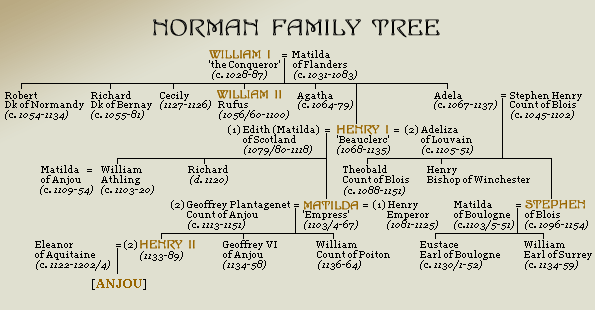
NORMAN TREE SHOWING STEPHEN'S LINE
The House of Anjou was referred to as the 'Angevins', one of the most powerful families that ruled in France. The Normans regarded the Angevins with contempt and had little desire to be ruled by one. Stephen was probably already in the minds of the nobles as a better option. Moreover, Stephen did have a claim to the throne of England, being the son of Henry's sister. For the barons, this was a legitimate claim.
CONTINUE READING ->>